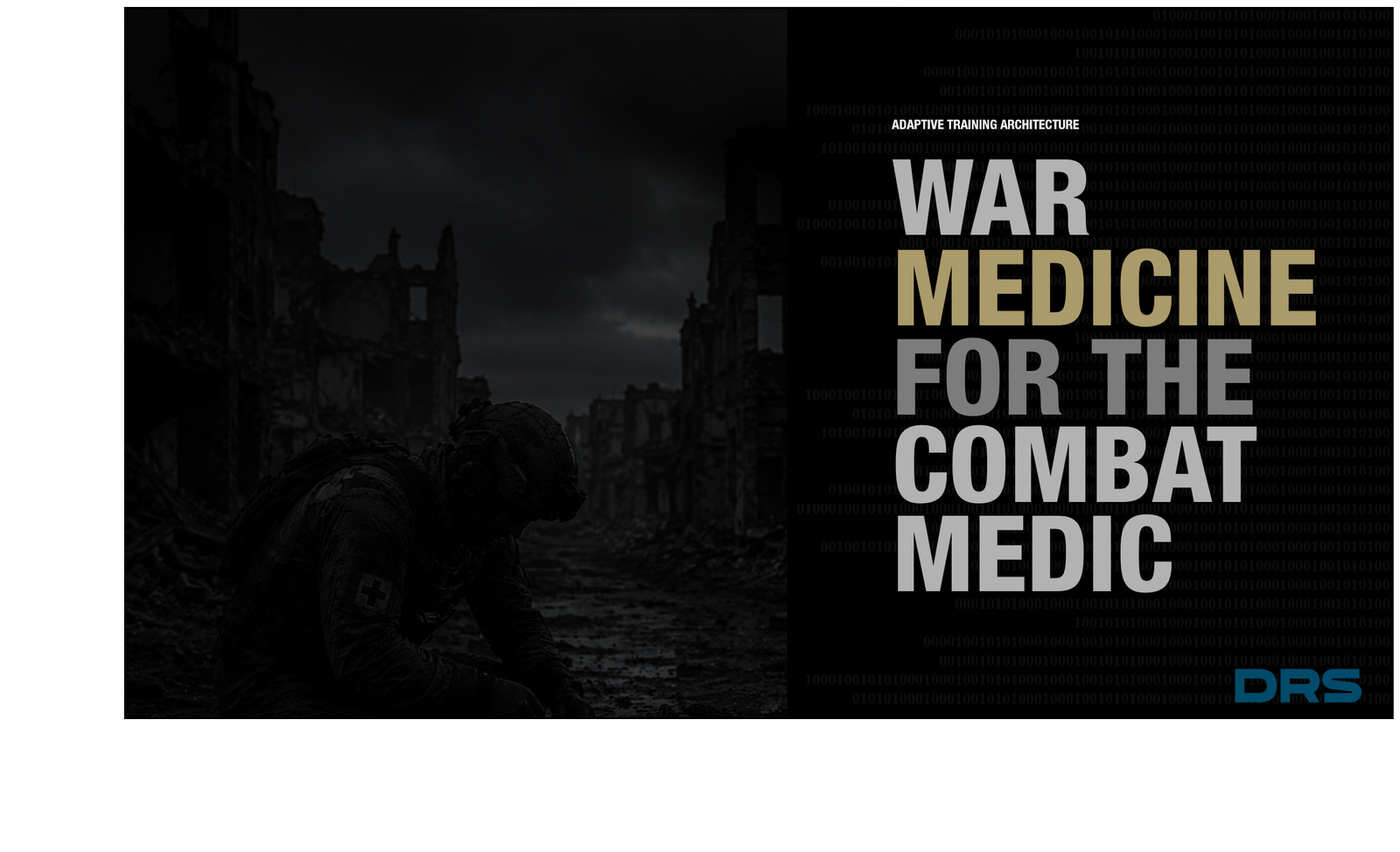
Adaptive Training Architecture

War
Medicine.
For the combat medic.

Digital pre-course · Physical course · Digital post-course. A gamification-based, algorithm-driven training system. The combat medic is not trained to diagnose disease — but to recognise critical patterns and execute the right decision- action pathway as a non-physician in the context of war.

MethodAlgorithm-driven · Gamified
OutcomeSave lives · Faster return to duty
DeveloperBergvild
Contents
01 — The Problem

Knowledge Gap, and time.

IN WAR, MEDICAL NEED EXCEEDS ACCESS TO LICENSED MEDICAL PERSONNEL. The critical task is therefore to lower the threshold for life-saving action by giving non-physicians a clear structure for identifying danger early and acting correctly under pressure.

This reduces unnecessary evacuations, protects limited transport capacity and PRESERVES SCARCE MEDICAL RESOURCES FOR THOSE WHO NEED THEM MOST

Symtom-based triage
Operating Principle
Trains filtering
not diagnosis. Recognise
patterns. Following the algorithm.
Save lives.
Pattern over diagnosis · Action over waiting
02 — Approach

One algorithm.

An algorithmic tool designed to lower the threshold for non-licensed personnel to save lives during crises and war, when demands are high and medical resources are limited.

01
Algorithm-Driven
An efficient decision system that helps non physicians save lives, act earlier and contribute when medical resources are limited.
02
Gamification-Based
Engagement engineered for retention. Threshold-driven progression — not exam-driven.
03
Distributed Digital
Pre and post phases delivered digitally. Adaptive simulation on representative patient cases.
04
Ecologically Valid
Field phase under realistic constraints. Differentiated paths for licensed personnel and combat medics.
03 — System

From symptom space to action.

A constant decision logic that operationalises the approach. Pattern over diagnosis. Triage over waiting. The same spine runs from observation to transport — across pre-course, physical course and post-course.

System — Subject · Algorithmic triage filter · Symptom cluster · Operational priority · Treatment triage · Evacuation or return to unit
01
Subject
02
Triage Filter
03
Cluster
04
Priority
05
Treatment
06
Evacuation or Return to Unit
Working Principle
Simple. Precise.
Life-saving when
licensed medical personnel are not available.
Method that performs when margins are small
04 — Architecture

Three phases. One algorithm across all of them.

Pre-course builds the decision pattern in a digital environment. Physical course applies it under field constraints. Post-course maintains it through adaptive retraining. The decision logic does not change between phases — only the environment does.

01
Pre-course
Digital · Gamified
Adaptive simulation on representative patient cases. Threshold-driven — not exam-driven. The learner reaches competence before entering the physical course.
02
Physical Course
Field · Scenario-Based
Segmented drill, then integrated scenarios under realistic constraints. Differentiated paths for licensed personnel and combat medics.
03
Post-course
Digital · Adaptive
Recurrent digital cases at 1 · 3 · 6 · 12 months. Sub-threshold performance routes the user into targeted retraining. Built for retention.
05 — Bergvild

Flexible, high-performance systems built for real constraints.

BergVild works to strengthen human, technical and societal systems so they remain flexible, adaptive and functional when tasks change, environments are unfavourable and margins are small. The work is transdisciplinary by design, integrating biomechanics, physiology, psychology, technology and organisational theory through ecological pedagogics and dynamical systems theory, wherever capability has to hold under real constraints.

Bergvild
Bergvild
Performance Systems
06 — About
Jonas Enqvist · PhD
Sports Scientist · Biomechanist

Jonas Enqvist is specialising in optimising performance in human and complex systems. He holds a Master’s degree in Physiology from Karolinska Institutet and a PhD in Biomechanics from The Swedish School of Sport and Health Sciences. With over 20 years of experience in elite sport, working with organisations and world class athletes, he is now broadening his work into other performance environments, including defence related medicine and tactical athlete performance.

The metod integrates biomechanics, physiology, psychology, technology and organisational theory through ecological pedagogics and dynamical systems theory. The goal is to build societal, technical and human systems that remain flexible, adaptive and perform when tasks change, environments are unfavourable and margins are small.

07 — Contact

Co-development.
Licensing. Capability integration.

Direct
Inquiries · Applied research · Training architecture · Operational medicine · Advisory.
QR — jonas@bergvild.se
Scan to email